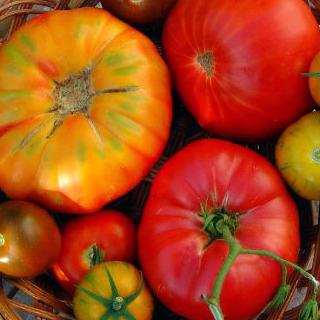
This fall I have decided to really ratchet up our farmers market buying, since if you can handle the volume the cost hardly increases. For example, to buy 4-5 nice tomatoes costs $3 now. But for $10, you can buy half a peck of tomatoes, which is a completely full shopping bag worth of them. Hundreds! So I bought a 1/2 peck and tonight blanched off all their skins, cut them in half, and froze them in freezer bags. I also made a large pot of fresh tomato sauce that I will freeze as well. Megan also mentioned canning, which would be the ultimate in farmers market preservation. It still scares me somehow, but I would love to try.
The second fun event is Megan's parent's apple tree had another bumper year this year, after taking last year off. Last weekend we went and picked two large boxes full, with 5 times as many still on the tree. Tomorrow D. and I are going to crush and press the apples to make a cider, that we plan on using in our next beer in place of most of the water. There will be lots of cider making this fall I hope!
Finally to make our 19th century lifestyle complete, Megan made a watermelon rind pie in honor of my Grandma's fabulous watermelon rind pickles. It is fantastic, with a very fall-like combination of nuts, spices, and raisins.
Enjoy the slideshow!
Showing posts with label food. Show all posts
Showing posts with label food. Show all posts
Wednesday, September 16, 2009

Friday, May 29, 2009
Rhubarb pie
 I'm not the only one who is making pretty looking food things. This morning Megan made this fantastic Rhubarb pie with ginger. Tart, sweet, and a a little spicy. Yum! I ate 1/4th of it after dinner..
But before that, it deserved some table-photo treatment!
Wednesday, March 18, 2009
CSA
 Now that the snow is gone and the sun has some warmth to it again, I'm starting to think about... vegetables! I just finished reading Michael Pollan's newest book, which starts with the simple suggestion to "Eat food. Not too much. Mostly plants." He goes on to describe how our industrialization of food has made us very confused about what's actually food and what's just "foodish". He also tracks the history of the science of nutrition, and how scientists love the reductionist approach to nutrition (e.g. the important parts of beef are the fats and proteins contained within it). But the nutrient's role in a food, or the food's role in a diet, or the diet's role in a lifestyle are nearly impossible to study, so nutrition science tends to overlook all that. The orange is healthy for you because of the vitamin C, or the fish is good because of omega-3 fatty acids. Never mind that epidemiologic studies have shown that a vitamin C pill doesn't provide the same benefits as eating an orange, and fish oil capsules don't provide the same benefits as eating a piece of salmon. We're finally realizing that food is more than just the sum of its parts (one of the main reasons that I think the "100% complete and balanced" claim on dog and cat foods is bunk).
But anyway, that quick summary doesn't do justice to the book- you'll have to read it yourself!
As summer is getting closer, I'm getting excited for the return of the farmer's market, but we're also considering joining a CSA (community-supported agriculture). To join a CSA, you purchase a share from a farm, who in turn delivers a weekly box of produce (or eggs, flowers, honey, or anything else the farm produces) to you. The downside- and upside- is that the contents of the box change depending on what's in season. You have to be a flexible cook to be able to take full advantage of what comes in your box, unlike going to the farmer's market where you can pick and choose what you want. You also don't get money back if pests or bad weather take out some of the farm's crops and you don't get a full box. The advantage is that you get to help support a local farm, and you provide a farm with a steady, reliable income throughout the growing season. CSA farms often open themselves to their supporters, encouraging members to come help with planting or harvesting and hosting events like corn roasts and pot lucks.
There's a huge list of Twin Cities-area CSAs at the Land Stewardship Project. Eener's Farm delivers to our local co-op... What do you think, should we go for it?
Sunday, December 16, 2007
More from Michael Pollan
The New York Times has a nice little article by Michael Pollan today about MRSA and Colony Collapse Disorder. The money quote:
We’re asking a lot of our bees. We’re asking a lot of our pigs too. That seems to be a hallmark of industrial agriculture: to maximize production and keep food as cheap as possible, it pushes natural systems and organisms to their limit, asking them to function as efficiently as machines. When the inevitable problems crop up — when bees or pigs remind us they are not machines — the system can be ingenious in finding “solutions,” whether in the form of antibiotics to keep pigs healthy or foreign bees to help pollinate the almonds. But this year’s solutions have a way of becoming next year’s problems.Let's just say that Swine Core did not leave me enamored with the swine industry...
Wednesday, November 14, 2007
Eat food. Not too much. Mostly plants.
Michael Pollan, the author of "The Omnivores Dilemma" that Megan blogged about in August, has a new book out in Janurary called, "In Defense of Food." It is based on his one rule for eating that Megan found a while ago in a 2007 article in the New York Times magazine. "Eat food. Not too much. Mostly plants." It is nice to see him expanding that point now into a book, it will be interesting to see where he goes with it.
Friday, August 10, 2007
The Omnivore's Dilemma
 I finished The Omnivore's Dilemma a few days ago, and have been mulling it over ever since... It's really a good read, although sometimes slipping into an over-the-top journalistic style that I didn't care for, and sometimes bending the truth a little (i.e. stating that cows naturally seek out certain plants based on their antibacterial properties if they aren't feeling well... a nice thought, but not true). Overall it's well-written, and the fact that it's gotten me thinking about how and what I'm eating at every meal since sure says something.
The basic premise of the book is that Michael Pollan, the author, attempts to trace four different types of meals from producer to plate. He starts with the industrial food chain, which is heavily based on corn, then moves to big organic (Whole Foods Market, Earthbound Farms, Cascadian Farms, etc), then small organic (locally produced and not shipped any farther than a farmer's market), then a "hunt and gather" meal that he made himself, mainly by hunting a wild boar in California and foraging for morels. He touches on so many aspects of food that it's impossible to comment on all of it here, but these are my favorite bits:
"From 1992 to 1997 Gene Kahn [founder of Cascadian Farms] served on the USDA's National Organic Standards Board, where he played a key role in making the standards safe for the organic TV dinner and a great many other organic processed foods. This was no small feat, for Kahn and his allies had to work around the original 1990 legislation, which had prohibited synthetic food additives and manufacturing agents outright. Kahn argued that you couldn't have organic processed foods without synthetics, which are necessary to both the manufacture and preservation of such supermarket products. Several of the consumer representatives on the standards board contended that this was precisely the point, and is no synthetics meant no organic TV dinners, then TV dinners were something organic simply should not do... Kahn responded with an argument rooted in the populism of the market: if the consumer wants an organic Twinkie, then we should give it to him. As he put it to me on the drive back from Cascadian Farm, "Organic is not your mother."... The final standards simply ignored the 1990 law, drawing up a list of permissible additives and synthetics, from ascorbic acid to xanthan gum."Pollan gives a very nice review of the history of organic foods, and how Big Organic has now squeezed most of the original philosophy out of the organic movement so that it can fit into an industrial market. Industrial organic farms are often just as large as any other industrial farms... They just don't use pesticides or chemical fertilizers. Better for the environment for sure, but the original organic movement aspired to be something more than that. People wanted to be more connected to their food. Is it a stronger connection to buy organic asparagus from Mexico, or to buy traditionally-raised apples from Northfield?
"Even if the vegetarian is a more highly evolved human being, it seems to me he has lost something along the way, something I'm not prepared to dismiss as trivial... We have been meat eaters for most of our time on earth. This fact of evolutionary history is reflected in the design of our teeth, the structure of our digestion, and, quite possibly, in the way my mouth still waters at the sight of a steak cooked medium rare. Meat eating helped make us what we are in a physical as well as a social sense. Under the pressure of the hunt, anthropologists tell us, the human brain grew in size and complexity, and around the hearth where the spoils of the hunt were cooked and then apportioned, human culture first flourished.
This isn't to say we can't or shouldn't transcend our inheritance, only that it is our inheritance; whatever else may be gained by giving up meat, this much at least is lost. The notion of granting rights to animals may lift us up from the brutal, amoral world of eater and eaten- of predation- but along the way it will entail the sacrifice, or sublimation, of part of our own identity- of our own animality. (This is one of the odder ironies of animal rights: It asks us to acknowledge all we share with animals, and then to act toward them in a most unanimalistic way.) Not that the sacrifice of our animality is necessarily regrettable; no one regrets our giving up raping and pillaging, also part of our inheritance. But we should at least acknowledge that the human desire to eat meat is not, as the animal rightists would have it, a trivial matter, a mere gastronomic preference. By the same token we might call sex- also now technically unnecessary for reproduction- a mere recreational preference. Rather, our meat eating is something very deep indeed."
I know this little excerpt sounds like the usual meat-eater's justification of carnivory (we evolved to do it!), but trust me, he explores the question of eating animals much more thoroughly than that. I just liked this paragraph because he gives meat eating a more complex value than I've ever given it. I will say that our obligatory food animal courses in vet school have made me seriously question eating pigs.
"Perhaps because we have no such culture of food in America almost every question about eating is up for grabs. Fats or carbs? Three squares or continuous grazing? Raw or cooked? Organic or industrial? Veg or vegan? Meat or mock meat? Foods of astounding novelty fill the shelves at our supermarket, and the line between a food and a "nutritional supplement" has fogged to the point where people make meals of protein bars and shakes. Consuming these neo-psuedo-foods alone in our cars, we have become a nation of antinomian eaters, each of us struggling to work out our dietary salvation on our own. Is it any wonder Americans suffer from so many eating disorders? In the absence of any lasting consensus about what and how and where and when to eat, the omnivore's dilemma has returned to America with an almost atavistic force."
Pollan describes the omnivore's dilemma as having the evolutionary advantage of being able to eat just about anything, but the disadvantage of having to figure out what's good to eat. I think about it every time I go to the co-op and see great food right next to a giant aisle of pills and supplements. How can Whole Foods extol the virtues of eating fresh, organic foods while at the same time offering magic missing nutrients guaranteed to prevent cancer, capture free radicals, and do the laundry? Somehow Americans aren't satisfied with getting everything we need from food.. There must be more, right? Acai, mangosteen, dark chocolate. What hole in nutrition are we trying to fill?
Subscribe to:
Posts (Atom)